

India's Hidden Drug Crisis: Inside the Trafficking Network
From International Borders to Local Neighbourhoods, Understanding the Business Behind Drug Addiction
What if the drugs threatening a young person's future entered India through a network operating thousands of kilometres away?A parent in Pune notices that their college-going son has become withdrawn. His expenses have increased, his academic performance has declined, and he avoids conversations about his new group of friends. The family initially assumes he is going through a difficult phase. They do not know whether drugs are involved, but they know something has changed.
Behind some cases of drug addiction lies a much larger problem. An illegal trade connects suppliers, organised criminal networks, financial intermediaries, and local distributors. Its effects reach families, educational institutions, workplaces, and neighbourhoods.
India's drug trafficking problem is not confined to international borders or headlines about major police seizures. It is a criminal business with serious public health, economic, and social consequences.Understanding how these networks operate is the first step towards recognising the threat and protecting our communities.
1. Drug Trafficking Is More Than an Illegal Transaction
Drug trafficking involves the illegal production, transportation, distribution, or sale of controlled narcotic drugs and psychotropic substances.Drug trafficking, drug possession, and drug use are different activities, although they sometimes intersect. Each has distinct legal and social implications.
For criminal networks, illegal drugs generate revenue. For people who develop substance use disorders, the consequences might include deteriorating health, financial difficulties, damaged relationships, and disruption to education or employment.
This is what makes the problem particularly difficult to address. Authorities must investigate and disrupt criminal supply networks, while healthcare professionals and communities must help prevent addiction and support people seeking recovery.An effective response needs both approaches.
2. What Do India's Drug Seizure Figures Tell Us?
Official enforcement figures provide an indication of the scale of the challenge. According to the Narcotics Control Bureau's year-end release dated 7 January 2026, the NCB seized 1,33,965 kilograms of narcotic drugs valued at approximately ?1,980 crore during 2025.
The Bureau also reported that it arrested 994 drug traffickers, including 25 foreign nationals, in 447 cases during the year.These figures relate to the NCB's reported enforcement activity. They should not be mistaken for the combined totals of every central and state agency operating across India.
The same release reported that 265 drug offenders were convicted in 131 cases during 2025. The NCB's reported conviction rate increased to 66.8%, compared with 60.8% in 2024.The Bureau also reported freezing assets worth ?96.69 crore in 70 cases involving suspected proceeds of narcotics trafficking.
These numbers reveal an important aspect of the response. Enforcement involves more than recovering illegal substances. Investigators also pursue prosecutions and examine the financial assets connected with trafficking.However, seizure figures alone do not reveal the total size of the illegal drug market. They tell us what authorities recovered, not everything that entered circulation.The wider challenge is to identify the networks behind the trade and prevent them from continuing their activities.
3. How Does the Trafficking Network Reach Local Communities?
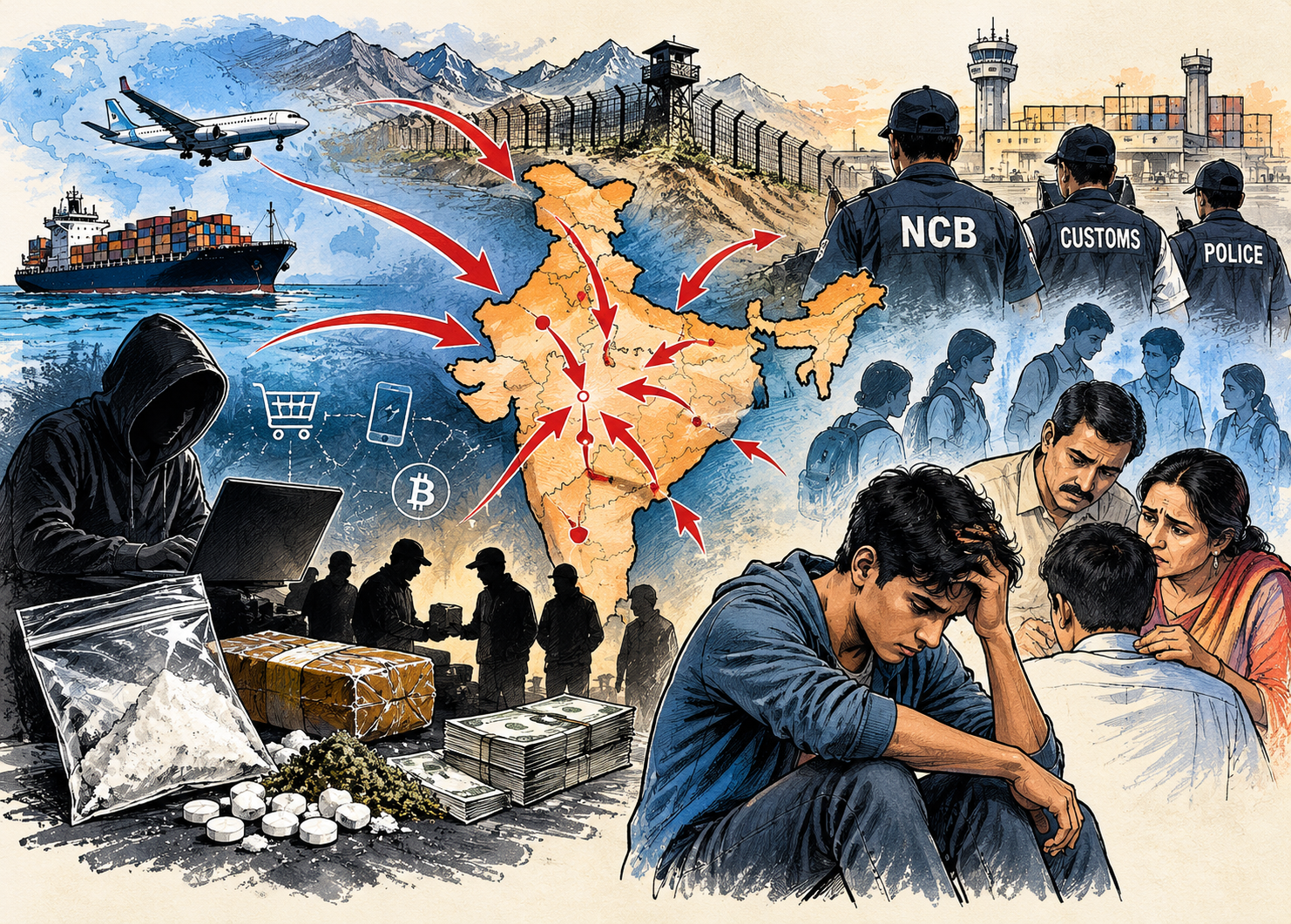
India's geographical position creates complex challenges for narcotics enforcement. The country shares international land borders, has an extensive coastline, and maintains busy commercial connections through airports, ports, and domestic transport networks.
These connections support legitimate trade and travel. Criminal networks attempt to exploit parts of this environment for illegal activities.
A trafficking operation might involve suppliers, financiers, transporters, intermediaries, and local distributors. Different groups might handle separate parts of the chain.
This makes investigations difficult. Arresting a person transporting a consignment does not automatically identify the people financing the operation or controlling the wider network.
Investigators must establish connections between individuals, examine financial records, gather admissible evidence, and determine whether separate cases form part of a larger criminal operation.
The objective is to disrupt the network rather than focus exclusively on the person caught at one point in the chain.
4. Why Technology and Financial Investigation Matter
Modern trafficking investigations increasingly involve digital evidence and financial analysis.Criminal networks might attempt to exploit online communications, digital transactions, courier services, and complex financial arrangements. Investigators must establish whether these activities are connected to an offence through lawful procedures and reliable evidence.Financial investigations are particularly important because the movement of money might reveal relationships that are not immediately apparent from a drug seizure.
A person caught carrying drugs might be one participant in a larger operation. Financial records, digital evidence, and cooperation between agencies help investigators examine the wider structure.Technology supports this work by helping trained investigators analyse information and identify potential connections. It does not replace reliable evidence, professional judgement, or due process.For organisations working in engineering and security, this is an important area of public interest. Lawful intelligence analysis, digital forensics, and responsible information sharing contribute to investigations into organised criminal activity.
5. Operation Trident: A Case Study in Network-Focused Enforcement
A recent example illustrates how investigators are looking beyond individual drug seizures. According to a Ministry of Home Affairs release published by the Press Information Bureau on 25 October 2026, the Narcotics Control Bureau spearheaded Operation Trident on 23 October 2026.The operation involved coordinated action across Assam, Mizoram, and Manipur, with 38 teams carrying out searches at 38 locations.The official release reported the following outcomes:
-
18 people arrested.
-
1,424 bank accounts frozen.
-
Properties valued at ?17.82 crore attached.
-
Approximately ?100 crore in suspected hawala transactions identified.
-
500 detonators and ?12 lakh in cash seized.
The operation involved coordination between the NCB, Mizoram Police, and the Enforcement Directorate, according to the official release.The investigation concerned a transnational trafficking network linked to movements across the Myanmar, Mizoram, Manipur, Assam, and Bangladesh region.One important aspect was the reported focus on financial connections alongside the operational activities of the suspected network.
Why does this matter?
Because a trafficking network depends on more than the movement of illegal substances. It also depends on financing, payments, coordination, and the ability to maintain its operations.Investigating these connections gives authorities additional avenues for disrupting organised criminal activity.The reported seizure of detonators is also significant as a separate enforcement finding, although it should not be confused with a narcotics seizure.Operation Trident demonstrates the importance of coordinated investigations. Its reported results should be understood as enforcement outcomes, not as proof that the wider trafficking problem has been eliminated.
6. The Human Cost Behind the Criminal Network
Statistics describe enforcement activity, but they do not fully explain what happens to families affected by addiction.A student who develops a substance use disorder might struggle to complete an education. A young professional might experience financial difficulties or lose employment. Parents might spend months trying to understand changes in their child's behaviour. Not every person who uses drugs develops an addiction, and addiction does not follow one predictable path. However, repeated use of certain substances increases the risk of dependence and serious health problems.
Families should pay attention to persistent changes in behaviour, unexplained financial difficulties, declining academic performance, and social withdrawal.These signs do not establish that someone is using drugs. They indicate that a conversation or professional assessment might be appropriate.Accusations and humiliation often make difficult situations harder to address. Calm communication, medical guidance, and appropriate counselling offer a more constructive response.Communities must also recognise the difference between people affected by addiction and individuals involved in trafficking offences. Health problems require appropriate care, while suspected criminal activity requires lawful investigation.
7. What Can Families and Communities Do?
Preventing drug-related harm requires participation beyond law enforcement. Parents should maintain open communication with their children and discuss peer pressure, substance use, and the importance of seeking help. Schools and colleges should provide age-appropriate drug education and make counselling resources accessible to students. Employers and community organisations should encourage awareness and provide information about professional support services. Citizens with credible information about suspected drug trafficking should report it through authorised channels rather than confront suspected offenders or circulate unverified allegations.
People concerned about their own substance use or that of a family member should seek help from qualified healthcare professionals or recognised de-addiction services. Public awareness becomes meaningful when people know what to look for, where to report concerns, and how to seek assistance without fear of stigma.
Conclusion: Disrupt the Network, Protect the People
Drug trafficking is a complex challenge involving criminal networks, illegal profits, vulnerable individuals, and serious public health concerns.India's enforcement efforts show why investigations must examine more than the substances recovered during an operation. Financial analysis, digital evidence, coordination between agencies, and effective prosecution all contribute to efforts against organised trafficking.Yet enforcement alone cannot prevent every case of addiction.Families need reliable information. Young people need support and awareness. Educational institutions need prevention programmes. People affected by addiction need access to treatment and rehabilitation.
Related Posts

Recent Posts

