

The Evolution of Security Systems: From Guards to AI-Powered Surveillance
Introduction
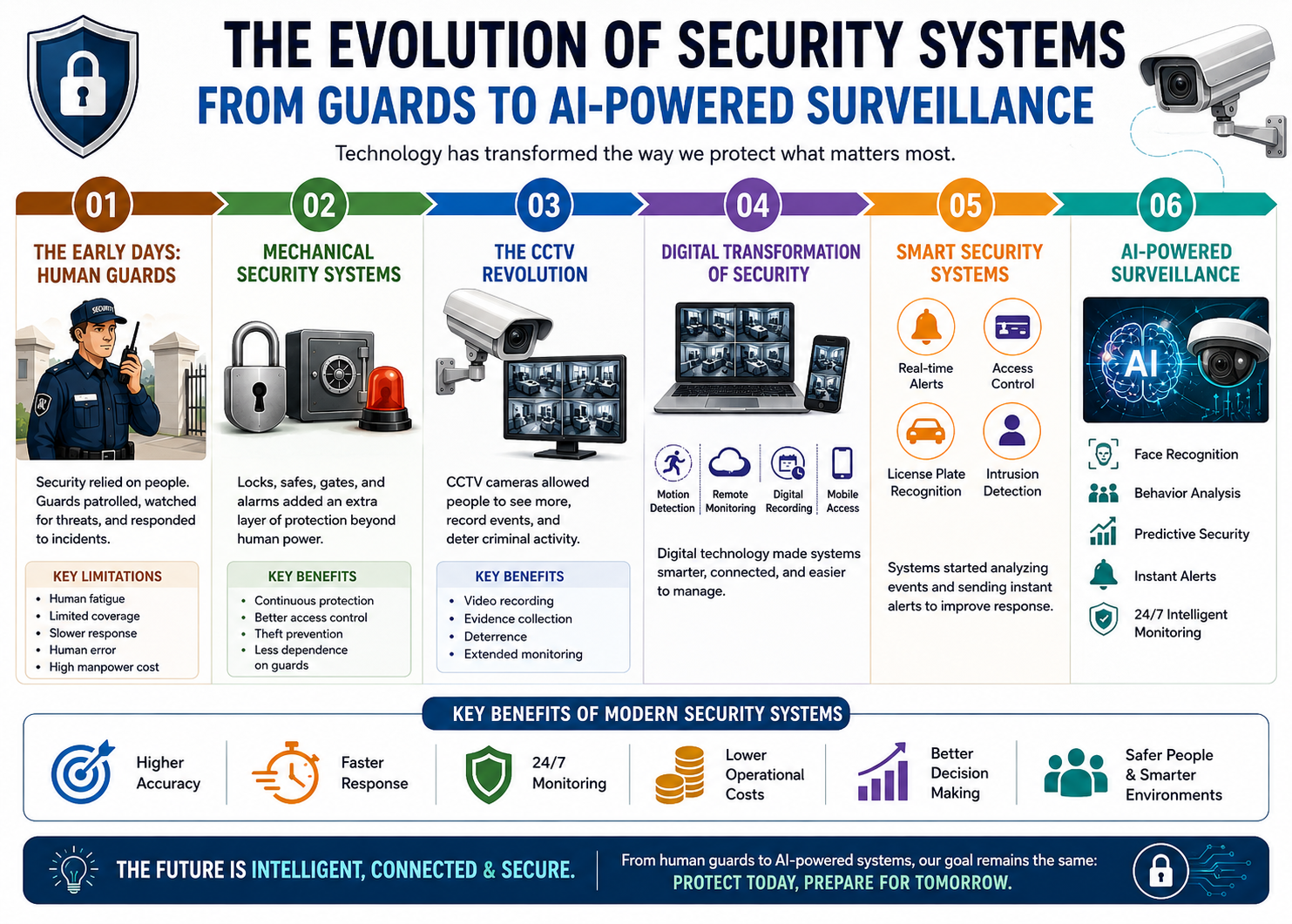
Imagine trying to protect a large building 100 years ago. There were no smart cameras, no motion sensors, and certainly no artificial intelligence. Security depended mostly on people. Guards walked around properties, watched for suspicious activity, and responded when something went wrong.
Fast forward to today, and security looks very different. Modern systems can detect unusual behavior, recognize faces, send instant alerts, and even predict potential threats before they happen. What once required a team of guards can now be supported by advanced technology working around the clock.
The journey from traditional security methods to AI-powered surveillance is a fascinating story of innovation.
The Early Days of Security: Human Guards and Physical Protection
For centuries, human guards were the backbone of security.
Whether protecting castles, banks, warehouses, or private homes, guards played a crucial role in maintaining safety. Their responsibilities included:
-
Monitoring entrances and exits
-
Patrolling properties
-
Checking visitor identities
-
Responding to emergencies
-
Preventing theft and vandalism
Human guards brought valuable skills such as judgment, experience, and decision-making. However, relying solely on people also had limitations.
Challenges of Traditional Guard-Based Security
Some common challenges included:
-
Human fatigue during long shifts
-
Limited ability to monitor large areas
-
Slower response times
-
Risk of human error
-
High staffing costs
As cities grew and businesses expanded, organizations needed more efficient ways to protect people and property.
The Rise of Mechanical Security Systems
The first major shift came with mechanical security solutions. Locks, safes, gates, and alarm systems became essential tools for protecting valuable assets. These inventions added an extra layer of security beyond human monitoring.
How Mechanical Security Changed Protection
Mechanical systems offered several advantages:
-
Continuous protection
-
Reduced dependence on guards
-
Better access control
-
Improved theft prevention
For example, a secure vault could protect valuable items even when no guard was present. While these systems were effective, they could not actively monitor situations or respond to threats. That challenge led to the next stage in security evolution.
The CCTV Revolution
The introduction of Closed-Circuit Television (CCTV) transformed the security industry. For the first time, businesses and property owners could visually monitor multiple locations from a central point. CCTV systems became popular because they:
-
Recorded activities
-
Provided evidence after incidents
-
Discouraged criminal behavior
-
Extended monitoring capabilities
Banks, airports, shopping centers, and government facilities quickly adopted surveillance cameras.
The Limitations of Early CCTV Systems
Although CCTV was a major advancement, it still had weaknesses. Security personnel had to watch screens continuously. Missing a critical event was easy, especially when monitoring dozens of cameras at once.Imagine watching 50 camera feeds for eight hours straight. Even the most alert person could miss something important. This challenge created a need for smarter surveillance solutions.
The Digital Transformation of Security
The arrival of digital technology brought significant improvements. Security systems became more connected, efficient, and easier to manage.
Some major innovations included:
Digital Video Recording (DVR)
Instead of relying on traditional tapes, digital systems stored footage electronically.
Benefits included:
-
Better video quality
-
Easier storage
-
Faster video retrieval
-
Longer recording periods
Motion Detection
Security cameras could now detect movement automatically. Rather than recording everything, systems could focus on important events. This saved storage space and made investigations easier.
Remote Monitoring
The internet changed security forever. Business owners could check camera feeds from computers, tablets, or smartphones. Security was no longer limited to a single control room. This connectivity laid the foundation for intelligent surveillance systems.
The Emergence of Smart Security Systems
As technology advanced, security systems became smarter. Modern surveillance solutions started doing more than simply recording footage. They began analyzing information. Smart security systems introduced features such as:
-
Real-time alerts
-
Automated monitoring
-
License plate recognition
-
Intrusion detection
-
Access control integration
These systems reduced the workload for security teams and improved response times. However, the biggest breakthrough was still ahead.
The Arrival of AI-Powered Surveillance
Artificial Intelligence (AI) has become one of the most important developments in modern security. Unlike traditional systems that only capture images, AI-powered surveillance can understand and analyze what it sees. This represents a major shift from passive monitoring to intelligent security.
How AI Enhances Surveillance
AI systems use advanced algorithms to process large amounts of visual data in real time.
They can:
-
Identify unusual behavior
-
Recognize faces
-
Detect unattended objects
-
Track movement patterns
-
Analyze crowd activity
-
Send instant alerts
For example, if someone enters a restricted area, an AI system can immediately notify security personnel. Instead of reviewing hours of footage, teams receive alerts only when attention is needed.
Facial Recognition and Identity Verification
One of the most well-known applications of AI in security is facial recognition. This technology compares facial features with stored databases to verify identities. Common uses include:
-
Airport security
-
Office access control
-
Law enforcement investigations
-
Smart building management
Facial recognition can speed up entry processes while improving security. However, organizations must also address privacy concerns and ensure responsible use of personal data.
Predictive Security: Preventing Threats Before They Happen
Traditional security systems react after an incident occurs. AI aims to change that. By analyzing patterns and behaviors, AI can help identify potential risks before they become serious problems.
Examples of Predictive Security
AI may detect:
-
Unusual movement patterns
-
Unauthorized access attempts
-
Suspicious loitering
-
Abnormal crowd behavior
This proactive approach helps organizations respond faster and reduce risks. Think of it like a weather forecast. Instead of waiting for a storm, you receive a warning in advance and can prepare accordingly.
The Benefits of AI-Powered Surveillance
AI-driven security systems offer several advantages over traditional methods.
Improved Accuracy
AI can analyze thousands of events quickly and consistently.
Faster Response Times
Instant alerts allow security teams to react immediately.
24/7 Monitoring
Unlike humans, AI systems do not get tired or distracted.
Reduced Operational Costs
Organizations can optimize resources and improve efficiency.
Better Decision-Making
Data-driven insights help security managers make informed decisions.
These benefits are driving widespread adoption across industries.
The Future of Security Systems
The evolution of security technology is far from over.
Future systems are expected to become even more intelligent and connected.
Emerging trends include:
-
AI-powered drones for surveillance
-
Smart city security networks
-
Advanced behavioral analytics
-
Cloud-based security platforms
-
Integration with Internet of Things (IoT) devices
Imagine a security ecosystem where cameras, sensors, access control systems, and AI software work together seamlessly to create a safer environment. That future is already beginning to take shape.
Balancing Security and Privacy
As surveillance technology becomes more powerful, privacy remains an important consideration. Organizations must balance safety with responsible data use.
Key priorities include:
-
Transparent security policies
-
Data protection measures
-
Regulatory compliance
-
Ethical AI implementation
Building trust is just as important as improving security. The most successful security systems will be those that protect people while respecting their privacy.
Conclusion
The evolution of security systems reflects humanity's constant effort to create safer environments. From guards patrolling gates to AI-powered surveillance analyzing real-time data, each stage has brought new levels of protection and efficiency.
While human expertise remains valuable, technology has dramatically expanded what security systems can achieve. AI is helping organizations detect threats faster, improve monitoring accuracy, and move from reactive responses to proactive prevention.
As innovation continues, security systems will become smarter, more connected, and more effective. The future of security is not just about watching what happens—it is about understanding, predicting, and preventing risks before they occur.
For businesses, institutions, and communities, embracing modern security technology is no longer just an option. It is becoming an essential part of building a safer world.


Recent Posts