


The Changing Face of the Global Drug Crisis: How G20 Countries Are Adapting Their Response
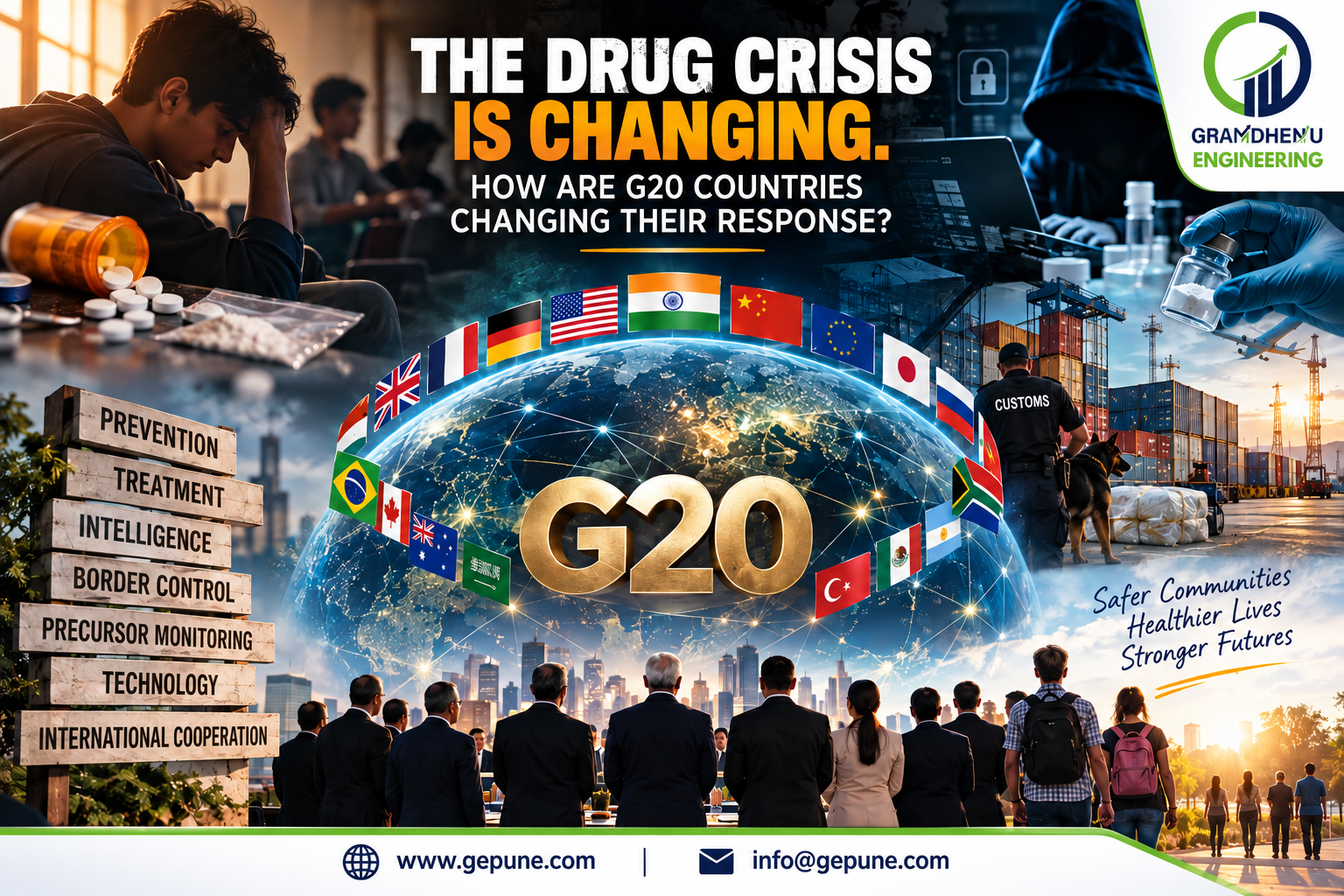
The Drug Crisis Is Changing. How Are G20 Countries Changing Their Response?
“The next drug crisis may not arrive in a suitcase. It may arrive as a small package, a chemical shipment, an encrypted message, or a new synthetic substance created in a laboratory.”
For decades, the public image of drug trafficking was relatively simple. A shipment crosses a border. Police intercept it. A trafficking network is investigated.
“The next drug crisis may not arrive in a suitcase. It may arrive as a small package, a chemical shipment, an encrypted message, or a new synthetic substance created in a laboratory.”
For decades, the public image of drug trafficking was relatively simple. A shipment crosses a border. Police intercept it. A trafficking network is investigated.
And somewhere at the end of this complicated chain is a human being.A teenager experimenting with a substance.A young professional struggling with addiction.A family trying to understand what happened to their child.A community dealing with the consequences.This is why the global drug problem is becoming one of the most difficult challenges for governments to address.
The G20 has recognised that the problem is bigger than policing
The G20 New Delhi Leaders’ Declaration put an important idea on the global table.
It recognised the “public health dimension” of the world drug problem while calling for stronger international counter-narcotics cooperation, including information sharing and capacity building to disrupt the production and trafficking of illicit drugs, synthetic drugs and precursor chemicals. That wording matters.It means the response cannot stop with police and customs.It has to include healthcare, prevention, rehabilitation, intelligence, technology, financial investigations, chemical regulation and international cooperation.
But the interesting question is not what the G20 wrote in its declaration.
The interesting question is:
What are countries actually doing?
India: Fighting the problem from prevention to trafficking
India's position makes the challenge particularly complex.The country has to deal with trafficking routes, organised networks, synthetic drugs, precursor chemicals and domestic drug use at the same time.The response therefore involves multiple layers.The Narcotics Control Bureau works with central and state agencies on drug-law enforcement, intelligence and international cooperation. India also works with other countries through bilateral agreements and cooperation mechanisms.
But there is another important side to the Indian response.Prevention.The Nasha Mukt Bharat Abhiyaan has focused on awareness, particularly among young people, along with counselling, treatment and rehabilitation.This is an important shift in thinking.
If a young person receives help before experimentation develops into dependency, the intervention is very different from trying to rebuild a life after years of addiction.
The fight against drugs therefore begins long before a police seizure.It can begin in a classroom.At home.In a college.In a community.
United States: Looking beyond the finished drug
The United States has increasingly focused on the supply chain behind synthetic drugs.
Its 2026 National Drug Control Strategy places significant attention on synthetic drugs, precursor chemicals, border detection and the role of international trafficking organisations.This approach is important because stopping the finished product is only one part of the problem.
Consider a manufacturing chain……
Someone needs chemicals………..
Someone needs equipment………
Someone needs transportation……
Someone needs money………
Someone needs communication.
Someone needs distribution.
If authorities identify the network at an earlier stage, they have more opportunities to disrupt it.This is why precursor chemicals have become such an important part of international drug-control discussions.
China: Tracking chemicals before they become illegal drugs
China provides another example of how the fight is moving upstream.
Its 2025 white paper on fentanyl-related substances describes systems for controlling precursor chemicals, including licensing, purchase and transportation controls, export verification and digital tracking. China also describes a national management system intended to collect information across the precursor-chemical supply chain.
China also reports international cooperation with countries and organisations on drug control, including information exchange and cooperation involving precursor chemicals.The underlying principle is simple.If a chemical has a legitimate industrial use, authorities cannot treat every movement of it as criminal.Instead, they need to understand who is buying it, where it is going, how much is being purchased and whether the transaction makes sense.
That requires data….It requires traceability….And increasingly, it requires digital systems.
Europe: When criminals change routes, governments have to change too
Europe's experience shows how quickly the drug market can adapt.
The European Union Drugs Agency's 2026 report describes trafficking networks shifting routes and methods in response to stronger enforcement. Authorities have reported the use of commercial containers, smaller ports, parcels, drones, maritime transfers and sophisticated concealment techniques. Synthetic drugs present another challenge.
Drug producers are experimenting with different chemicals and production methods. Some are using substances designed to remain outside existing controls.These are sometimes referred to as “designer precursors.”The problem is obvious.A government regulates one chemical.Traffickers move to another.Authorities identify the replacement.The criminals modify the process again.Europe is responding by strengthening precursor monitoring, risk assessment, international cooperation and digital systems. The European Commission has proposed measures including faster reporting of significant precursor seizures and stronger controls on designer precursors. This is becoming a race between innovation in criminal networks and innovation in law enforcement.
Japan: International cooperation before drugs reach the consumer
Japan illustrates another side of the problem.Its Narcotics Control Department works with foreign law-enforcement agencies to investigate international drug trafficking and disrupt illicit flows into Japan. It also participates in international forums and programmes involving organisations such as UNODC and the International Narcotics Control Board.The lesson is important. A country does not have to wait until drugs arrive inside its cities.International cooperation can begin at the source, transit point or shipping route.
Australia: The health of people remains part of the equation
Australia's approach places strong emphasis on reducing drug-related harm to individuals, families and communities.Its National Drug Strategy combines demand reduction, supply reduction and harm reduction. Australian policy also emphasises prevention, treatment and community-based responses alongside law enforcement.This brings us back to the human side of the issue.
A successful drug-control strategy is not measured only by how many shipments are intercepted.
It also has to ask:
How many young people received help?
How many people entered treatment?
How many families received support?
How quickly were dangerous substances identified?
How effectively were trafficking networks disrupted?
Technology is becoming the new frontline
There is one common thread running through these different approaches.
Technology.
The next generation of drug-control systems will depend increasingly on the ability to connect information from different sources.AI-assisted data analysis can help investigators identify unusual patterns.Digital chemical-tracking systems can help regulators follow legitimate supply chains.Advanced scanning technologies can support customs and border agencies.Secure intelligence platforms can help agencies share information across jurisdictions.Forensic technologies can help identify new substances.Early-warning systems can alert authorities when unfamiliar synthetic compounds begin appearing.Technology will not replace police
officers, doctors, customs officials, researchers or counsellors.It gives them better information and, ideally, more time to act.
The real battle is not happening only at the border
This is perhaps the biggest lesson from the G20 discussion.
The drug crisis does not begin at the border.It begins much earlier.It begins when a vulnerable young person is exposed to drugs.It continues when criminal networks find a new supply route.It grows when precursor chemicals are diverted.It becomes harder when information remains trapped inside separate agencies.And it becomes a public health crisis when people cannot access timely treatment and rehabilitation.
That is why the G20's approach is important. Its message is not simply “stop drugs.”It is about connecting countries, intelligence, healthcare, technology, enforcement and prevention.
From G20 commitments to real-world protection
The future of drug control will not be decided by one country acting alone.A chemical supplier might be in one country.The manufacturing operation might be in another.The financial transaction might pass through a third.The shipment might travel through several ports.The buyer might be sitting in a completely different country.
The response therefore has to be equally connected.India is strengthening prevention, enforcement and international cooperation.The United States is focusing heavily on synthetic drugs, precursor chemicals and trafficking networks.China is strengthening precursor controls and digital traceability.
Europe is adapting to new trafficking methods and designer chemicals.Japan is strengthening international investigations and cooperation.Australia combines supply reduction with prevention, treatment and harm reduction.Different countries are using different tools.But the direction is increasingly similar.
Detect earlier. Share information faster. Disrupt supply chains. Control precursor chemicals. Use technology intelligently. Prevent addiction. Treat people. And work across borders.
The G20 declaration gave this global challenge a common language.The real work is happening after the declaration, inside laboratories, ports, police stations, hospitals, schools, customs systems, technology platforms and communities.And ultimately, the success of these efforts will
not be measured only in tonnes of drugs seized.It will be measured in something far more important.
Recent Posts

